Complementary shields and their symbolism: from Aeneas' to Sam Houston’s
Throughout human history, the
shield has been a vital piece of military equipment. Everyone, from the quiet
peasant to the highest Nobel would have used or had access to one (Kelly). In
Roman culture, the shield is especially important since it was the mark of a warrior
and trumped the sword and spear. The importance of shields to the Romans is even
seen in the Aeneid, through Virgil’s lengthy description of Aeneas’
shield. However, Aeneas’ shield in particular, differs from most Roman
shields because of its symbolism, brought by both the usage of the shield and the
unique selection of decorative and historical scenes. Having a shield with many
symbols also raises the question of what a shield would look like for a warrior
like General Sam Houston. Therefore, the purpose of this essay is to first, describe
the symbolism of Aeneas’ shield and why some of the images were chosen, and
second, to illustrate an Aeneas-styled shield for Sam Houston.
As stated previously, symbolism within Aeneas’ shield is initially seen through the simple use of this military weapon. For example, Virgil uses the shield’s natural ability to withhold impacts as a symbol of Rome’s strength to overcome its enemies and subdue the hardships of civilization (“Aeneas’s Shield”). By acknowledging the fact that shields are carried into battle, Virgil also symbolizes Aeneas, the carrier of the shield, as the literal carrier of Rome’s future (“Aeneas’s Shield”).
We further see this idea of Aeneas’ shield representing Aeneas’ fate of building a grand civilization, and Rome’s destiny of becoming a great city, through the figures on Aeneas’s shield. In general, these scenes describe Rome’s “future” history, which includes Romolus and Remus, the Rape of the Sabine Women, and the battle of Actinium (Virgil and Lombardo). For Aeneas, whose sole purpose in the Aeneid is to establish a city, having these future events on his shield represent his fate to build the city he was determined to create. Having the same images displaying a prevailing civilization also represent the greatness that Rome is destined to achieve over the years (Ewing).
As stated previously, symbolism within Aeneas’ shield is initially seen through the simple use of this military weapon. For example, Virgil uses the shield’s natural ability to withhold impacts as a symbol of Rome’s strength to overcome its enemies and subdue the hardships of civilization (“Aeneas’s Shield”). By acknowledging the fact that shields are carried into battle, Virgil also symbolizes Aeneas, the carrier of the shield, as the literal carrier of Rome’s future (“Aeneas’s Shield”).
We further see this idea of Aeneas’ shield representing Aeneas’ fate of building a grand civilization, and Rome’s destiny of becoming a great city, through the figures on Aeneas’s shield. In general, these scenes describe Rome’s “future” history, which includes Romolus and Remus, the Rape of the Sabine Women, and the battle of Actinium (Virgil and Lombardo). For Aeneas, whose sole purpose in the Aeneid is to establish a city, having these future events on his shield represent his fate to build the city he was determined to create. Having the same images displaying a prevailing civilization also represent the greatness that Rome is destined to achieve over the years (Ewing).
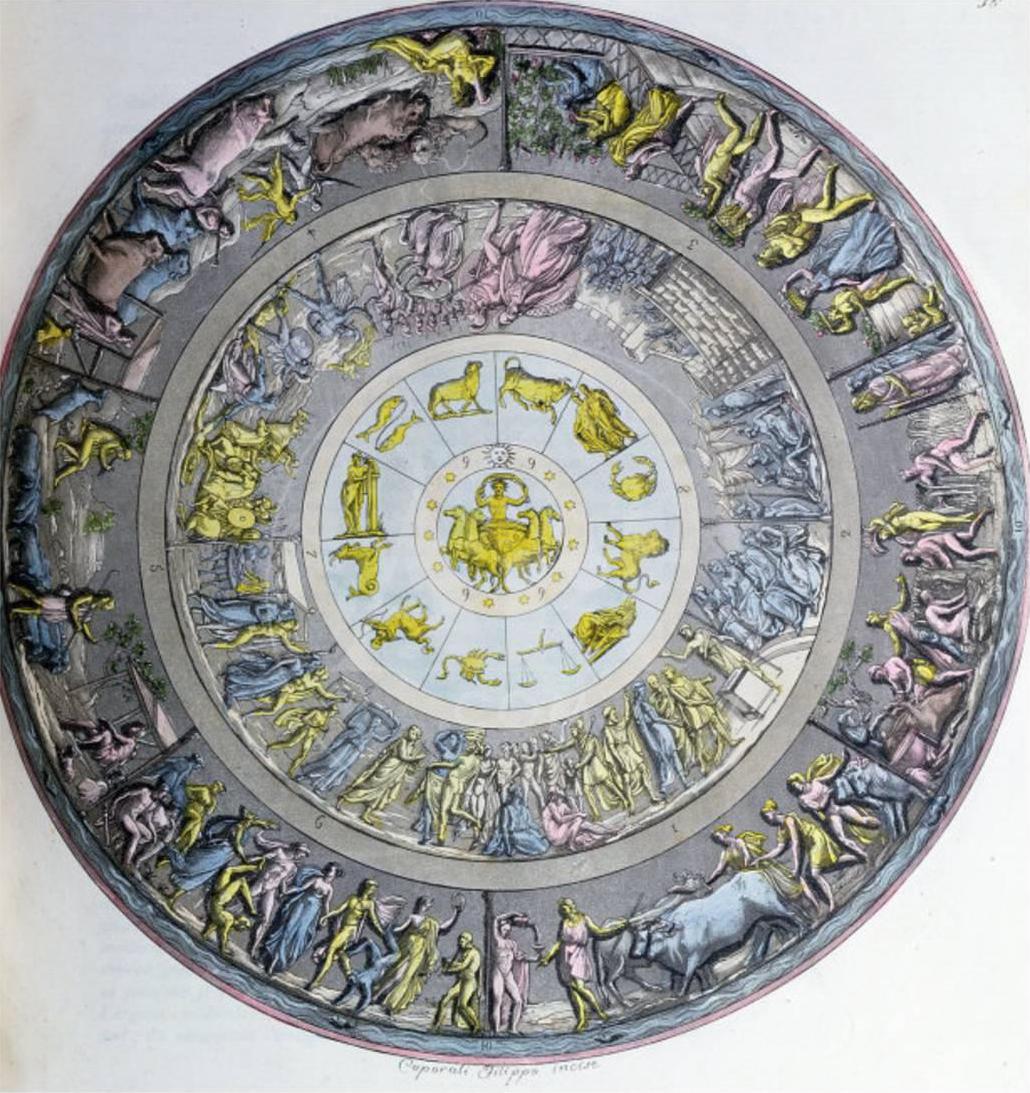 |
| Illustration of Shield of Aeneas |
However, one can’t avoid asking the
question if Rome was really destined for greatness, or if the images on the
shield were selected to make readers believe it was. Many historians agree that
scenes on the shield were biasedly chosen by Virgil to support Augustus as the
righteous ruler of Rome. After the battle of Actium, Rome was in a state of political
unrest. The Roman republic was effectively abolished, and Augustus was proclaimed
the only leader of the new Roman empire. Augustus wanted to reawaken the Roman
sense of national pride, unity, ancestral religion, and traditional moral values,
and commissioned Virgil to write the history of Rome (Williams). Virgil, a
country man and enthusiastic supporter of simple virtues and religious
traditions, supported Augustus’ promise of a reborn Rome and wrote the
Aeneid to embody his ideal, contemporary, Augustinian Rome. Virgil also uses the Aeneid to draw obvious parallels between Aeneas and Augustus, and directly honours Augustus
in the shield of Aeneas by describing his success in the battle of Actium and
depicting Augustus’ shining head connecting with the star of Julius Caesar (Leithart).
Ultimately, the scenes in the shield were selected as propaganda to promote
Augustus as the great and divine leader of Rome.
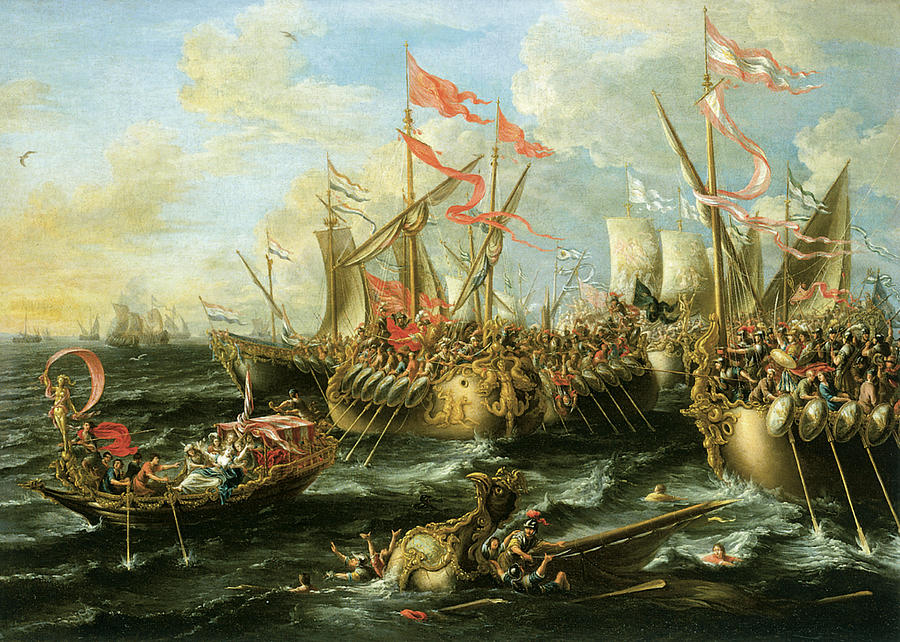 |
| Battle of Actium |
Nevertheless,
having a shield whose images are used to promote one’s success is not unusual.
Surely anyone who is entering battle wants to display their strength and
superiority, even if it’s through semi-historical scenes. For example, if an
Aeneas-type shield were to be created for Sam Houston, a Texas Hero, before
going into the battle of San Jacinto, he would certainly have scenes like Aeneas,
representing historical events and symbols that shaped Texas into the powerful state
it is today (History.com editors).
One of the first images that would be included
within Houston’s shield is the Alamo with the words “Remember the Alamo” near
it. The Alamo was a fort where Texan soldiers died fighting for the state’s
independence against Mexico. The battle that took place in this mission was a
pivotal event in the Texan revolution, and served as a symbol of the Texan’s
heroic resistance to the Mexicans and the state’s struggle for independence. To
Sam Houston, the Alamo was also a source of inspiration, since many believe the
defeat at the mission is what drove him to fight, and win, at the battle of San
Jacinto. The phrase “remember the alamo” would also be significant since it too
stands as symbol of the desperate fight of the Texan defenders in the Alamo (“Remember
the Alamo, 1836”).
| Alamo |
Another
essential figure placed in Houston’s shield would be the lone star. To all Texans,
this star symbolizes Texas’ former status as an independent republic, and as a
reminder of the state’s struggle for independence from Mexico. To Houston, the
star would also represent his destiny as Texas’ first president, since his
victory in the Battle of San Jacinto, which gained Texas’ independence, influenced
many to nominate him as the independent state’s first leader. Today, the Lonestar
continues to serve as a symbol for Texas, as seen in the state’s flag and the
state’s nickname as the Lonestar state (McKenzie).
 |
| Texas Lone Star |
A third
figure to include on Sam Houston’s shield would be a geyser of oil exploding
from the Spindletop well. The economy of the state has primarily been based on
the energy industry since the early 1900’s when oil was discovered in
Spindletop (“Explore the History of Houston”). In fact, the oil industry is so
important to Texas, that economist believe its presence is one of the main contributors
to the state’s success and growth (Reavis). Therefore, showing Spindletop, the
origin of the state’s lucrative oil and gas industry, would be a symbol of Texas’
wealth and power. To Sam Houston, it would also serve as a symbol of the success
Texas will achieve without the aid or control of Mexico.
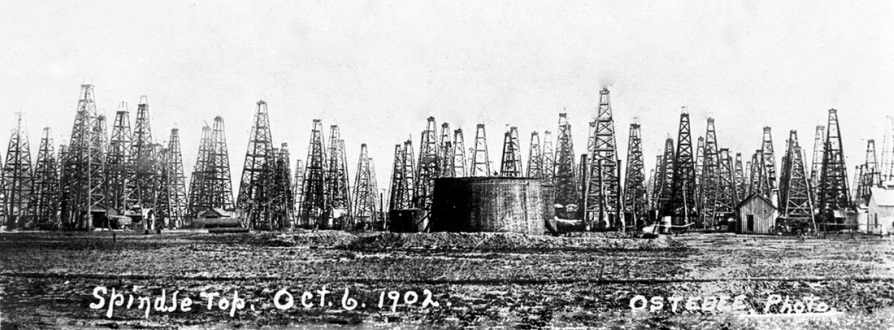 |
| SpindleTop, 1902 |
There is
an abundance of other symbols that may be placed in Sam Houston’s shield. Some
may include NASA, a herd of cattle, a cowboy, or even the Mexican flag. However, the purpose of these images is to represent the previous or current events that made
Texas into the grand state it is today. Therefore, by creating a shield for Sam Houston, that mimics the shield of Aeneas, we can see the importance of understanding the symbolism brought by figures or scenes. Symbols are powerful tools that give the author the ability to effectively convey a message in a poetic way, rather than stating it outright. Without symbolism of some kind, a story becomes nothing more than a two-dimensional series of boring events. Symbolism, in its many forms, weaves together all the contrasting threads of a story into a coherent whole, while adding intellectual depth and emotional resonance.
Works Cited
Ewing, Grace. “Shield of Aeneas.” Prezi.com, 2 Dec.
2016, prezi.com/a0x1bzzonp2n/shield-of-aeneas/.
History.com Editors. “Sam Houston.” History.com,
History, 9 Nov. 2009, www.history.com/topics/mexico/sam-houston.
“Houston Historical Timeline.” Explore the History of
Houston, Greater Houston Partnership, www.houston.org/timeline.
Kelly, Patrick. “The Shield: Its Use and Development.” MyArmoury.com,
myarmoury.com/feature_shield.html.
Leithart, Peter. “Shield of Aeneas.” Leithart,
Patheos , 7 Sept. 2017,
www.patheos.com/blogs/leithart/2005/12/shield-of-aeneas/.
“Aeneas's Shield Symbol Analysis.” LitCharts,
www.litcharts.com/lit/the-aeneid/symbols/aeneas-s-shield.
McKenzie, Phyllis. “Texas Lone Star.” Texas Cultures,
texascultures.housing.utexas.edu/assets/pdfs/lonestar.pdf.
Reavis, Dick L and Will Van Overbeek. Texas. Random House, 2004, ISBN 978-0-676-90502-1
‘Remember the Alamo!," 1836.” Fight to the Death at the Alamo, 1836, 2009, www.eyewitnesstohistory.com/alamo.htm.
The Aeneid Symbols.” Course Hero, www.coursehero.com/lit/The-Aeneid/symbols/
‘Remember the Alamo!," 1836.” Fight to the Death at the Alamo, 1836, 2009, www.eyewitnesstohistory.com/alamo.htm.
The Aeneid Symbols.” Course Hero, www.coursehero.com/lit/The-Aeneid/symbols/
Virgil, and Stanley Lombardo. The Essential Aeneid.
Hackett Pub. Co., 2006
.
.
Williams, Robert Deryck. “Virgil.” Encyclopædia
Britannica, Encyclopædia Britannica, Inc., 26 July 1999, www.britannica.com/biography/Virgil.


I like how you established the importance of shields in your introduction, this provides relevance for your paper. I also liked how clear your essay organization was. Moreover, the visuals you used were super cool and captivating. I liked how you used a culture relevant to you in the metaphorical construction of your shield. Also, the use of symbolism itself as a concluding topic for your essay also made the overall essay more engaging.
ReplyDeleteI appreciated your well-researched writing. I don’t have a lot of connections to Texas, so it was interesting to hear what you had to say about a figure like Sam Houston. From what you had to say, there certainly are parallels that can be drawn between the spirit of Texan independence and the kind of Roman pride that Augustus was trying to cultivate for the Romans (even if I don’t anticipate the Texans attempting to conquer the Gulf of Mexico anytime soon).
ReplyDeletePatricia,
ReplyDeleteIt’s cool to read your essay and see how different it is from the one I wrote on the same topic! I like how you make the shield very personal for Aeneas. I like how you tied the description of the shield to what was happening politically with Rome at the time to give it perspective. The way you write is very engaging. I definitely didn’t know that much about Sam Huston or the history of Texas so I thought that portion of your paper was really interesting. Your conclusion was good, too, in saying that symbolism helps glue a story together and give it depth. I enjoyed reading your essay! Thanks for sharing!