Culture and Architecture: Pre-Greeks and Now
John Lautner would argue that the
purpose of architecture is to “Improve human life. To create timeless, free,
joyous, spaces for all activities in life...” (Lautner). Others may add that
architecture is a product of the culture that it was designed for, and that
architects seek to design spaces for the times and people who will use them (“Architecture
Reflects Culture”). One may see this philosophy of architecture within the pre-Greek
civilization (Minoans, Mycenaeans, and Athenians) which effortlessly displays
the connection between a society’s culture and its buildings. These
civilizations created the foundation of classical architecture which has
dominated the western world for centuries and continues to influence modern
architecture today. Therefore, the purpose of this essay is to explore how the architecture of the ancient Greeks reflects the
culture of their civilization, and how they compare with modern governmental
buildings in Washington D.C.
 |
| Palace of Knossos |
Much of what we know about the Minoans is speculated since the civilization was discovered just over 100 years ago through the unearthing of the Palace of Knossos (Hatch). This palace is thought to be a sprawling architectural complexity; it spans nearly 6 acres and contains up to 1300 rooms connected by a complex drainage system, narrow corridors, and elaborate underground passages (Insalaco).
By analyzing the palace’s unique
layout, archeologist and architects have been able to better interpret the
function of Knossos, and ultimately
the culture of the Minoans. For example, some believe that most Minoans
actually lived in Knossos instead of
having private dwellings due to the variety of spaces that intertwine with each
other, the numerous storerooms found, and the presence of water and sewage
systems within Knossos (Insalaco and “History
of Knossos”). This theory makes the palace seem more like a multi-use urban
complex where everyone was allowed to fulfill their daily functions in one
spot. However, the relationship between the palace and the power structure of
the civilization it is not clear. If anyone was allowed access into the palace,
could the Minoans be a somewhat egalitarian society? Or could the solidarity of
the palace show the exertion of a localized control on materials and on the surrounding
towns? (Cartwright, “Minoan Civilization”). Hopefully, further archeological work
may help us better answer these questions and understand the political
structure of the Minoan world.
 |
| Lion Gate |
Many Minoan palaces also lacked obvious fortifications, which some propose is the clearest difference between Mycenaean and Minoan architecture (Bohl). The lion gate, marking the main entrance to the citadel of Mycenae is a great example of Mycenaean bulwark architecture. This gate was constructed using cyclopean masonry which is defined as huge unworked boulders that are roughly fitted together with no clay or mortar between them (Bohl). Atop the three by three-meter doorway is an eighteen-ton, three-meter, triangular stone with two lions and a column between them (Cartwright, “Mycenae”).
The presence of this massive
fortification surrounding an acropolis suggests that the Mycenaeans had a less
peaceful co-existence with other communities in comparison to the Minoans
(Insalaco). The need to use cyclopean masonry reveals how the Mycenaeans were mindful
of displaying their physical strength and power to foreigners (Bohl). Having
lions in the arch of the gate has also been deduced to be a Mycenaean symbol of
power to both subjects and foreigners. Ultimately, the interpretation of Mycenaeans
being militaristic, preoccupied with displaying power, and a powerhouse of
ancient Greece agree with Homer’s portrayal of the Mycenaeans in the Iliad (“The Bronze Age” and Homer and
Stanely Lombardo).
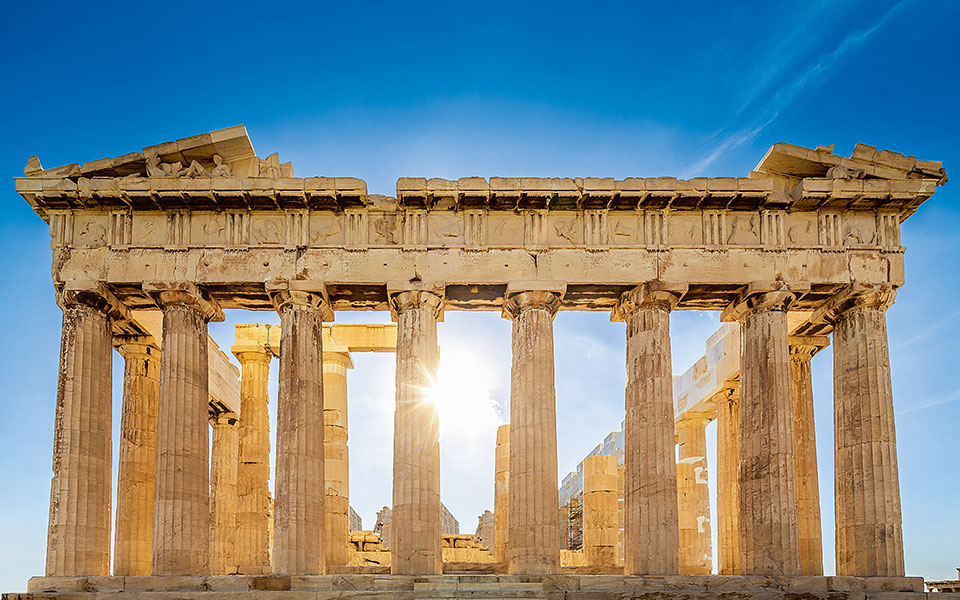 |
| The Parthenon |
The theme of displaying power in Mycenaean civilization is only enhanced during the Athenian age, as seen through the architecture of the Parthenon. This temple was originally built to house a massive statue of the goddess Athena (Bury and Russell 367-369) and sits on the Athenian acropolis where a Mycenaean palace one stood (“The Parthenon”). The Parthenon is also known for its simple geometric shape that follows the golden ratio and its iconic fluting columns (most likely inspired by Minoan columns) that slightly taper towards the top to compensate for the effect in which columns with straight lines appear to be slender in their middles (Dimitrova).
The sheer size of this temple along
with its unprecedented precise geometry set the Parthenon apart from all other temples in the age of the Athenians.
In fact, historians believe that the Parthenon
sought to out-shine all other temples of the time (Sakoulas). This theory shows
how the Athenian citizens were a civilization that was proud of the historical
magnitude of their ideas and sought to display their intellectual and financial
superiority. We may also argue that the perfect proportions of the Parthenon and its intricate
architectural elements represent the Greek’s belief of Athens as an
intellectually superior society. By applying and understanding concepts such as
attention to detail and a mathematically explained harmony in the natural world,
Athenians concluded that their advanced knowledge set their civilization apart
from the barbarians/rest of the world (Sakoulas).
Having this temple, which was
accessible to most Athenians (“The Parthenon: Religion, Art, and Politics”) in
a place where a Mycenaean palace once stood also symbolizes the Athenian
transition into a more democratic society. In fact, democracy was the essence
of Athenian thinking and was at center stage while the Parthenon was being built, as seen by the sculptures of common
people engraved within the walls of the Parthenon
(Sakoulas).
When we see the Lincoln Memorial, it’s no surprise that a building commemorated to
someone who fought to create a more egalitarian society, mimics the structure
of the Parthenon (“Lincoln
Memorial”). This temple-like memorial
was constructed out of marble, and the exterior is surrounded with thirty-six tapering
fluted columns, representing the thirty-six states in the Union at the time of
Lincoln’s death. The interior of the memorial is also divided into three
chambers, with the central chamber housing a nineteen-foot statue of Lincoln (“Lincoln
Memorial”).
 |
| Lincoln Memorial |
The similarities between this building and the Parthenon are obvious; both buildings have tapering columns, follow the golden ratio, and have commemorative statue in middle. Even Henry Bacon, the architect of the memorial, accredited the Parthenon for his inspiration (“Lincoln Memorial”). All in all, the creation of the building represents the free and democratic society that Lincoln and the United States have worked so hard to build.
However, the architecture of the memorial
also has multiple similarities with Minoan and Mycenaean buildings. For
example, the Lincoln Memorial
replicates the theme of transitioning space seen in Minoan architecture through
its three chambers that serve different functions and softly gradate into each
other. The Mycenaean theme of displaying power is also seen through the simple
act of having a Greek temple design that many thought was far too ostentatious
for a man of Lincoln’s humble character (Thomas).
There are also large differences
between the architecture of this memorial and that of the ancient Greeks. Archeological
evidence shows that many pre-Greek buildings were colorful, yet the memorial
and other governmental buildings designed after Greek architecture are almost exclusively
white (Insalaco and Haynes). The limestone used to create the memorial was also
sourced from a variety of places whereas the Parthenon was made from stone found near the Athens area. Finally,
the roof of the Parthenon is
triangular shaped, yet the Lincoln
Memorial is rectangular. Did Bacon know about color in Athenian temples? Is
there a symbol behind the location of the limestone for both the Parthenon and
the Memorial? And what causes the change of roof structure? We may not know the
answer to these questions, yet we may infer that the architecture of the Lincoln Memorial was undoubtedly
influenced by the culture and architecture of the Athenians along with the Minoans
and Mycenaeans.
To conclude, it is evident that the
creation of buildings reflects the culture and needs of its people, whether it
is for protection or religious reasons. We may also argue that the needs of a
civilization change as a function of chancing cultural customs, attitudes, and
beliefs. For example, the Minoan’s multi-use urban complex show the
practicality of their civilization, whereas the complexity of Athenian temples
portrays their desire to display their knowledge and superiority to foreigners.
Even in our modern world, we see how culture and architecture go hand in hand;
shopping malls are created to satisfy out consumerism culture, apartments are
built in cities to aid the increasing number of people that desire an urban
lifestyle, and more schools are built to allow humanity to continue its pursuit
for knowledge. Hopefully, thousands of years from now, the remnants of our
modern buildings will help others understand what human life was like in the
twenty first century, just how we currently use ruins of the Minoans, Mycenaeans,
and Athenians to evaluate the culture of their civilizations.
Works Cited
“Architecture Reflects
Culture.” PDH Academy, 24 Mar. 2016 pdhacademy.com/2016/03/28/architecture-reflects-culture/.Bohl, Mike. “Lion Gate.” Archaeologies of the Greek Past,
Brown University, www.brown.edu/Departments/Joukowsky_Institute/courses/greekpast/4918.html.Bury, J. B., and Russell Meiggs. A History of Greece to
the Death of Alexander the Great. 3rd Ed., Revised by Russell Meiggs.
Macmillan, 1972.Cartwright, Mark. “Minoan Civilization.” Ancient History
Encyclopedia, Ancient History Encyclopedia, 29 Mar. 2018,
www.ancient.eu/Minoan_Civilization/.Cartwright, Mark. “Mycenae.” Ancient History
Encyclopedia, Ancient History Encyclopedia, 15 Feb. 2020,
www.ancient.eu/mycenae/.DIMITROVA, MONIKA. “The Optical Tricks of the Parthenon.” TheMayor.EU,
25 Jan. 2018, www.themayor.eu/en/the-optical-tricks-of-the-parthenon.Hatch, Peter. “Knossos.” Archeologies of the Greek Past,
Brown University, 11 Dec. 2008, www.brown.edu/Departments/Joukowsky_Institute/courses/greekpast/4796.html.Haynes, Natalie. “Culture - When the Parthenon Had Dazzling
Colours.” BBC, BBC, 22 Jan. 2018,
www.bbc.com/culture/story/20180119-when-the-parthenon-had-dazzling-colours.“History of Knossos.” Labrynth, www.labyrinthpark.gr/en/history-of-knossos.Homer, Stanley, et al. The Essential Homer: Selections
from the Iliad and Odyssey. Hackett Pub., 2000.Insalaco, Amy. “Early Greece.” MyHistro, 2016,
www.myhistro.com/story/early-greece/193786#!mycenaean-civilization-531653.Lautner, John. “The Purpose of Architecture.” The John
Lautner Foundation, 10 May 2011, www.johnlautner.org/wp/?p=710.“Lincoln Memorial Design and Symbolism.” National Parks
Service, U.S. Department of the Interior, 10 Apr. 2015,
www.nps.gov/linc/learn/historyculture/lincoln-memorial-design-and-symbolism.htm.Sakoulas, Thomas. “The Parthenon.” Ancient-Greece.org,
ancient-greece.org/architecture/parthenon.html.“The Bronze Age on the Greek Mainland: Mycenaean Greece
-Mycenae.” Mycenean Greece, Foundation of the Hellenic World,
www.ime.gr/chronos/02/mainland/en/mg/habitation/citadels/index3.html.“The Parthenon.” Barbarism and Civilization, 20 Jan.
2016, www.civilization.org.uk/greece/fifth-century/parthenon.

I liked how in your introduction you addressed many perspectives of your overall topic; it was a very creative way to start your essay. Also, the use of questions in your essay expanded my mind on the topic and captured my attention. It was cool how you proposed that Minoans could have been “a somewhat egalitarian society.” Moreover, your transition between discussing the Mycenaean and Minoan architecture was very smooth and the details in your essay painted a picture of the details of the societies. Overall, I liked how you conveyed symbolism in your essay, especially when you discussed the architecture of the Lincoln memorial.
ReplyDeletePatricia, I think you made several intriguing points throughout your essay. I liked what you said about the buildings reflecting the culture and the needs of the civilizations. Obviously, ancient people built their buildings to last for long periods of time. Now, though, I wonder if modern buildings are constructed with the same thought. I know the apartment I live in is old and, in turn, falling apart. I do not think it would last hundreds of years, but I do think the more important, valued buildings are built with that goal. Buildings and their architecture change with the morals and culture of the people, like you said. Your essay leads me to wonder, also, about different materials used for buildings and if that could also indicate some cultural preference. Overall, I was struck by your essay and your proposed questions— they really made me think! Thanks for sharing!
ReplyDelete